
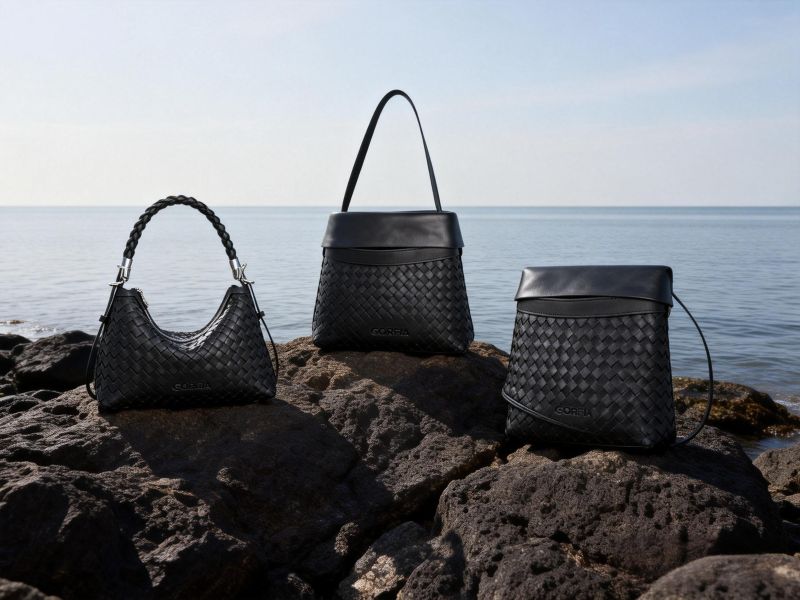
Woven purses are fast-selling wholesale items, yet many buyers still treat them as trend products rather than items with clear production rules. This guide shows how early clarity on materials and order size helps avoid over-ordering, margin loss, and uneven quality.
Buyers who confirm materials, durability standards, and factory limits early usually tend to see fewer sample revisions, see fewer defects, and keep reorder costs stable. Appearance-only approval often results in rising costs, delivery delays, and quality issues as volumes grow.
This guide explains how to turn a woven purse from a design idea into a product that can be reordered reliably. Let’s dive in.

Benefits of Black Woven Purses for B2B Buyers — Commercial Metrics to Track
Targeted margin: Black woven purses should deliver wholesale gross margins of 30–50%. Depending on retail markup and brand positioning. B2B buyers must evaluate margin at the landed cost level to ensure repeatable profitability at scale.
Risk reduction: As a functional bag rather than a decorative accessory, it has durable weaving and reinforced handles. Tested trims can reduce return rates by 1–2%, materially improving net margin on high-volume purse SKUs.
Scalability indicator: Supplier throughput must support growth from pilot MOQs to replenishment volumes without quality drift. Ensuring the purse can transition from a seasonal test item to a core range bag.
Procurement Assessment — Product Types and Materials
This section evaluates purses from a sourcing and commercial viability perspective, separating product form from material choice to support clearer procurement decisions.

Product Type — MOQ, Margin, and Repeat-Buy Potential
| Product Type | Typical MOQ | Margin/Volume Profile | Repeat-Buy Potential | Supply Feasibility Notes |
| Large Tote (Commercial Tote) | 500–2,000 units per SKU (higher with custom hardware) | Strong volume at entry–mid price tiers; margins depend on material selection | High for mass retail & promotional programs with standardized packaging | Choose suppliers with stocked trim libraries to reduce lead-time risk |
| Woven Tote Bag | 300–1,500 units | Moderate margins; growth via seasonal colors & limited editions | Moderate–High for core colorways | Low tooling requirement; avoid complex embellishments in first runs |
| Woven Shoulder & Crossbody Bags | 500–2,500 units (hardware & lining dependent) | Higher unit cost; strong everyday-use demand; handwoven leather = lower volume, higher margin | High for functional daily styles | Require strap pull-test data & zipper cycle validation |
| Clutches & Small Bags | 300–1,000 units (higher for bespoke metalwork) | Higher per-unit margin; lower total volume; good for capsule drops & promotions | Project-based rather than continuous | Fine finishing & tooling increase sampling cost and lead time |
The figures above reflect typical industry ranges observed across mid- to large-scale bag manufacturers.

Material — Supply Risk and Operational Implications
Natural materials (straw, jute):
- Seasonal availability, variable fibre quality, and fluctuating MOQs increase planning risk
- Higher inspection rejection rates require buffer time and stock
Coated fabrics and technical textiles (PU, nylon):
- More consistent supply, predictable pricing, and lower defect rates
- Better suited for scalable, repeat-buy woven purse programmes
Leather (handwoven or trim-based):
- Premium positioning with higher margins but lower volume
- Requires tighter QC controls and supplier transparency on sourcing and finishing
Key Features to Consider — How These Factors Help You Compare Suppliers
- Size and fit — Confirm exact dimensions (item width, item length, height to top) and include tolerance bands. Accurate specs reduce sample rounds and approval delays.
- Material specification — Supply material codes, datasheets (abrasion, tensile, dye fastness), and origin statements. Compare woven bag materials wholesale options based on test data, not marketing copy.
- Construction & hardware — Ask for tensile/strap-pull test results and zipper cycle tests. Request photos of seam construction at 5x magnification where relevant.

How to Evaluate Suppliers — Practical Steps for Brand Buyers
- Capacity & throughput — Request documented monthly capacity ranges by complexity and production line counts. Ask for historical run sheets for comparable runs.
- Quality systems & certifications — Need evidence of social compliance and quality management (e.g., BSCI, ISO 9001). Ask for recent audit summaries, not just certificates.
- Sampling & revision policy — Clarify the sample lead time, the number of included revisions, and the sample fees. Require photo/video evidence of sample approvals.
- Communication & transparency — Insist on named points of contact, a documented update cadence. This includes weekly production photo/video updates and escalation pathways.
- Logistics & flexibility — Confirm storage/consolidation options and the ability to ship partial containers. Experience with relevant incoterms (EXW/FOB/DDP).
Assortment Planning and Sizing for Wholesale Catalogues
Provide the purchaser with spec sheets and “what fits inside” visuals for each SKU. You should employ SKU families (core tote, shoulder, small clutch) to reduce SKU proliferation. For trans-seasonal strategies, prefer trans-seasonal woven bag suppliers. That can run short colour cycles and provide small-batch reorders (500–1,000 units) to test market acceptance.
Sustainability and Material Compliance — What Procurement Should Require
Sustainability claims should be verifiable. Ask distributor for material certificates, 25% recycled content by weight, mill test reports, and statements on animal-skin usage. Prioritise eco-friendly handcrafted woven bags. Only when accompanied by process documentation and consistent QC outcomes. For compliance. Require third-party test reports where applicable (e.g., restricted substances).

Manufacturing Profile — Archetype of a Reliable Medium-to-Large Factory
- Footprint & workforce — Example archetype: 7,500 m² production area, 150+ employees, with dedicated lines for specific product families.
- Monthly capacity & lead time — An archetypal factory should be able to show the most significant monthly outputs for comparable SKUs—for example, up to 200,000 units per line per month. And realistic reorder lead-times (e.g., 1 month for standard repeat orders).
- Quality & compliance — Published inspection regimes (pre-production, in-process, final) and recognized certifications reduce audit friction.
- One-stop operational services — They include in-house mock-up capability, routine photo/video updates, and short-term local storage for consolidation. These operational capabilities reduce logistical risk and shorten the time-to-market.
Design, Customisation & Cost Control
Standardise trims and hardware across related SKUs to reduce tooling and increase order flexibility. Negotiate tooling amortisation clauses and MOQ discounts tied to multi-SKU runs to unlock cost efficiencies.
Packaging & Logistics — Specification Items to Lock Early
Define polybag specs, hangtag data, carton dimensions, and carton strength tests in the PO. Packaging choices materially affect freight and damage rates. That also includes in landed cost calculations.

Pricing Strategy for Wholesale Lines
Use tiered pricing by MOQ bands. Build a live landed-cost model that includes—unit price, sampling amortisation, inspection, freight, duties, and expected return allowance.
What to Request from Suppliers — Supplier Documentation & Data Checklist
When you contact a potential supplier, request the following before committing:
- Current capacity statement (monthly throughput by SKU complexity).
- QC & audit reports (recent social compliance and QC audit summaries).
- Sample policy and lead times (number of included revisions and sample fee schedule).
- Material datasheets and test reports (abrasion, tensile, dye fastness, restricted substances).
- Hardware and trim part numbers and any tooling cost breakdowns.
- Packing specs and carton test results.
- Shipping & consolidation options and typical FOB/EXW lead times.
- References or historical run examples for clients with comparable volumes.

FAQs — Sourcing, OEM & Compliance Focus
Q: What is a typical MOQ for woven black purses?
OEM MOQs typically range from 300 to 2,500 units per SKU. Depending on complexity, negotiate lower MOQs when you standardise trims across SKUs.
Q: What certifications should I request from suppliers?
A: Request social compliance reports and quality-management evidence (e.g., BSCI, ISO audit summaries). Always ask for the audit summary, not just a certificate scan.
Q: What testing data should be non-negotiable?
A: Strap pull/tensile tests, zipper cycle counts, stitch density, and color-fastness reports. Include these as contract appendices.
Q: How quickly can a supplier scale from pilot to complete runs?
A: Verify documented capacity and historical run sheets. Reliable suppliers should show predictable ramp profiles. And explain constraints (material lead time, tooling).
Q: What information reduces sample iteration cycles?
A: Complete tech packs with exact dimensions and tolerance bands, material part numbers, and hardware specs. Require a documented sample revision window.
Q: How should customisation costs be handled?
A: Request tooling cost breakdowns and amortisation schedules. These include MOQ tiers that absorb tooling costs based on expected volume.
Final Thoughts
By standardizing specs, vetting suppliers rigorously, and aligning MOQs with reorder plans, you can turn black woven purses into consistent, high-margin core SKUs. For deeper supply chain insights, check our guide on ethical woven bag manufacturing.
Get Your Free Woven Purse Sourcing Quote
As a B2B specialist in woven purse production, we deliver reliable MOQs, strict QC, and flexible OEM solutions. Ready to build profitable, scalable SKUs? Request a free quote today.